Wild Care for people and nature +977 9766383035 | ✉️ info@wildcare.org.np


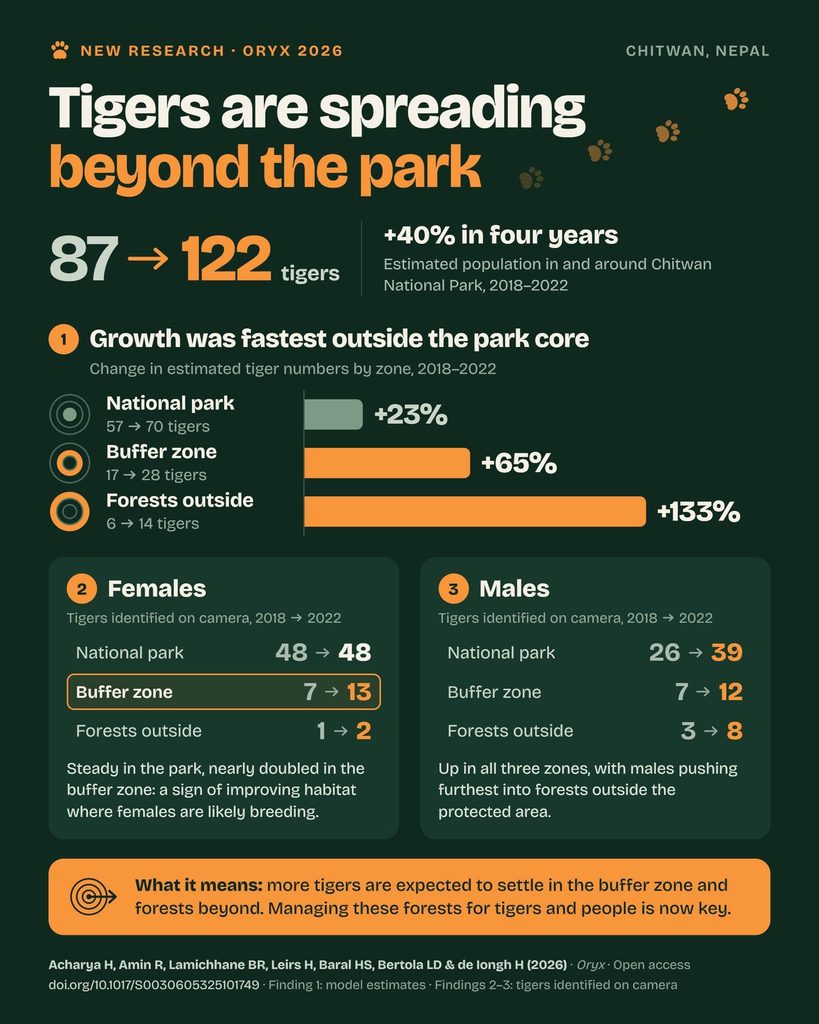
A new peer-reviewed study published in Oryx – The International Journal of Conservation has revealed important changes in the distribution and population dynamics of tigers (Panthera tigris) in and around Chitwan National Park, Nepal.
Co-authored by Dr. Babu Ram Lamichhane, Researcher at Wild Care Nepal, and Prof. Hans H. de Iongh, Advisor to the organisation, the study examines changes in tiger numbers across the national park, its buffer zone and adjoining forests outside the protected area.
Drawing on camera-trap data from Nepal’s national tiger surveys conducted in 2018 and 2022, the researchers used spatial population modelling to assess tiger numbers, distribution and movements across these three management zones.
Key findings:
- Tigers increased from about 87 to 122 in four years (+40%).
- Growth was fastest outside the park core: +23% inside the national park, +65% in the buffer zone and +133% in forests outside the protected area.
- Female tigers held steady inside the park (48) but nearly doubled in the buffer zone (7 → 13), a sign of improving habitat where females are likely breeding.
- Male tigers increased in all three areas.
🌳 Why it matters
More tigers are expected to settle in the buffer zone and nearby forests in the coming years. These are the same forests where local people cut grass and graze livestock, and where most tiger attacks on people take place. Managing these forests well, for both tigers and people, is now more important than ever.
Wild Care Nepal congratulates Dr. Babu Ram Lamichhane, Prof. Hans H. de Iongh and all co-authors on this important contribution to tiger conservation research in Nepal.
Read the full open-access research paper: https://doi.org/10.1017/S0030605325101749